HURT 100: 100 Miles Through the Mountains of Oahu
When I moved to Oahu and first hiked the trails of Manoa Valley in 2019, I got passed by a man running and laughed at this showoff who thought he could run in these mountains. There’s no way that guy is keeping that pace up this mountain, I thought. What is he even doing?
Then I found out about HURT.
The Hawaii Ultra Running Team’s HURT 100 is a 100-mile trail race through the Honolulu Forest Reserve. Five 20-mile loops on rooted, muddy, technical single-track winding through Makiki, Tantalus, and Manoa Valley. Roughly 24,500 feet of climbing. A 36-hour cutoff. Only about 40% of starters finish in a typical year.
I started power-hiking up those same trails and gained confidence. So I threw my name in the hat for 2022 and got waitlisted. On November 5th, I was offered a slot, giving me exactly 8 weeks to train for a hundred-miler.
I jumped at it.
The Training: 8 Weeks with Dr. Alyx Barnett
I called Dr. Alyx Barnett in a panic and asked her to help develop a training plan for a “skinny-ass road runner” to attempt this thing. I was in good shape from marathon training, but road running is just different. The elevation and technical trails will absolutely eat your road legs alive.
Alyx got me into serious strength training. Heavy leg work. Heavy lower body work. Lots of low-cardio hill sessions to build durability without burning myself out before the race. The goal was simple: make the quads bulletproof. A 3:19 marathon in December was just a training run along the way.
Her program worked. My quads didn’t start tiring until around mile 90.
Race Day: January 15-16, 2022
The race starts at 6:00 AM at the Hawaii Nature Center in Makiki Valley. You run five loops of roughly 20 miles each through the forest reserve trails above Honolulu. The course gains and loses about 5,000 feet per lap on steep, technical, root-covered trail. You pass through aid stations at the Nature Center after each loop, plus several stations out on the course.
Lap 1 — Finding Out Fast (5:37)
I slipped on a wet rock coming down Manoa and strained my hamstring on the very first lap. I couldn’t believe it. Eighty more miles to go and I was already hurt. I genuinely thought it was over.
But I made myself a promise at the start: as long as my body was capable of moving forward, I would continue to do so.
I limped back into the Nature Center and my wife Morgan was there. She got me patched up and back out the door.
Lap 2 — Grinding (6:43)
The hamstring made running downhill nearly impossible. I shifted to power-hiking and found a rhythm. The second lap took over an hour longer than the first, and the sun was going down. The mental math was brutal. At this pace, the 36-hour cutoff was going to be razor-thin.
Lap 3 — The Dark Hours (7:37)
Lap 3 was entirely in the dark. This is where the Kogalla Ra belt light earned its weight in gold. It’s a waist-mounted LED that throws an incredibly wide, even beam at ground level. On technical roots and rocks in the dark, it was absolutely illuminating compared to a headlamp. I cannot recommend it enough for night trail running.
This was also when I got my first pacer. Having someone with me in the dark, on those ridgelines, completely changed the game. I stopped spiraling and just focused on the next step.
Lap 4 — The Crew (7:39)
My pacers rotated through and kept me moving. Ben Carruth, Brendan Fitzgibbons, Genna Heaps, and Aaqib Syed each took shifts. My wife and the pacers operated like a pit crew at each aid station, getting me in and out with fresh socks and shoes, food, and refilled bottles. I knew I only had 2-3 minutes per stop and no time to spare.
By this point, my heart rate had settled to about 116 bpm. I wasn’t running anymore. I was just walking with purpose.
Lap 5 — Bring It Home (7:48)
The final lap. Math said I had just enough time, but no margin for error. Every step mattered. The volunteers at each aid station believed in me and kept me honest. The people cheering from afar, sending texts and tracking my progress, gave me fuel I didn’t know I needed.
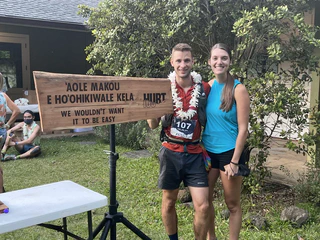
I rang the finishing bell at 35:24:58.
38th place out of 48 finishers. Only 48 of the 123 starters made it. My only goal was to finish, and I did.
By the Numbers
| Lap 1 | Lap 2 | Lap 3 | Lap 4 | Lap 5 | Total | |
|---|---|---|---|---|---|---|
| Time | 5:37 | 6:43 | 7:37 | 7:39 | 7:48 | 35:24 |
| Cumulative | 5:37 | 12:20 | 19:57 | 27:37 | 35:25 | |
| Avg HR | 143 | 131 | 116 | 116 | 116 | 124 |
- Elevation Gain: ~24,500 ft (official) / 26,700 ft (GPS)
- Max Heart Rate: 164 bpm
- Elevation Range: 333 ft to 1,917 ft
Gear List
Shoes
- La Sportiva Bushido II — Used for the first two laps. Great grip on the technical sections.
- Salomon Speedcross — Switched to these for laps 3-5. Lighter and more comfortable for the power-hiking phase.
- I swapped shoes and Smartwool socks every single lap at the Nature Center. Fresh feet are everything in a race this long.
Vest
- Salomon S/Lab Ultra — Carried everything I needed. Comfortable for 35 hours straight.
Lighting
- Kogalla Ra Belt Light — A waist-mounted LED that lights the ground in front of you with a wide, even beam. Far superior to a headlamp on technical trail at night. This was a game-changer for the dark laps.
Nutrition
Early on, I tried to eat as much as possible knowing my stomach would eventually shut down. The strategy was front-load calories while I still could.
Early laps: Chicken, fruit, and homemade coconut-chocolate-blueberry rice bars that Morgan made.
Late laps: Mashed potatoes and gummy bears. That was about all I could get down.
Throughout: Lots of Skratch Labs hydration mix. I estimate I drank somewhere around 2,000-3,000 calories in liquid alone over the 35 hours.
What I Learned
I believe anyone can run this race if they put their mind to it. We are all much stronger than we know. It’s important to test our limits and push through the dark moments when it’s easier to give up. Life is worth suffering for.
The people around me are the reason I finished. Morgan on the support crew. Alyx building the training plan. Ben, Brendan, Genna, and Aaqib pacing me through the worst hours. The volunteers who staffed aid stations for 36 hours in the Hawaiian forest. Every single one of them believed in me when I didn’t believe in myself.
At the end of the day, the race was simple. I just had to keep moving forward.
